Yo Baby Yo Baby Yo Yo Baby Yo Baby Yo Gif
 | |
| Availability | 500 BC – present |
|---|---|
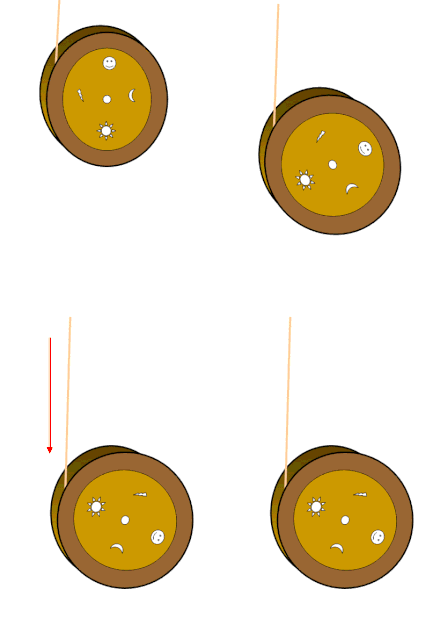
A sit-in, repeating just the downward motion of a yo-yo
 | Look upward yo-yo in Wiktionary, the costless dictionary. |
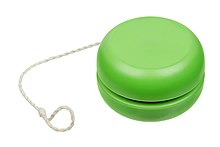
A yo-yo (as well spelled yoyo) is a toy consisting of an beam connected to 2 disks, and a cord looped around the axle, like to a spool. It is an ancient toy with proof of existence since 500 BCE. The yo-yo was also called a bandalore in the 17th century.
Information technology is played past holding the costless end of the string known as the handle (by inserting 1 finger—ordinarily the eye or ring finger—into a sideslip knot), allowing gravity (or the force of a throw and gravity) to spin the yo-yo and unwind the string (similar to how a pullstring works). The player then allows the yo-yo to wind itself back to the histrion's hand, exploiting its spin (and the associated rotational energy). This is often called "yo-yoing".
In the simplest play, the cord is intended to be wound on the spool by mitt; the yo-yo is thrown down, hits the end of the cord then winds up the string toward the paw, and finally the yo-yo is grabbed, ready to be thrown again. I of the most basic tricks is chosen the sleeper, where the yo-yo spins at the end of the string for a noticeable amount of fourth dimension before returning to the hand.
Etymology and history [edit]
The word yo probably comes from the Ilocano term yóyo, or a cognate word from the Philippines.[1]


A 1791 illustration of a adult female playing with an early on version of the yo-yo, which was then called a "bandalore"

Lady with a yo-yo, Northern India (Rajasthan, Bundi or Kota), c. 1770 Opaque watercolor and gilded on newspaper
A Greek vase painting from 440 BC shows a boy playing with a yo-yo (see right).[2] Greek records from the flow describe toys fabricated out of wood, metal, or painted terracotta (fired dirt).[2] The terracotta disks were used to ceremonially offer the toys of youth to certain gods when a child came of age—discs of other materials were used for actual play.
First yo-yo company [edit]

Afterward the yo-yo was introduced to the United States, it spread to Mexico—a pile of handmade wood Mexican yo-yos is pictured.
In 1928, Pedro Flores, a Filipino immigrant to the United States, opened the Yo-yo Manufacturing Visitor in Santa Barbara, California.[three] The business started with a dozen handmade toys; by Nov 1929, Flores was operating ii additional factories in Los Angeles and Hollywood, which all together employed 600 workers and produced 300,000 units daily.[iii]
The master stardom betwixt the Filipino pattern popularized by Flores and more than archaic yo-yos is in the way the yo-yo is strung. In older (and some remaining cheap) yo-yo designs, the cord is tied to the axle using a knot. With this technique, the yo-yo just goes back and forth; it returns easily, just it is impossible to make it sleep. In Flores'south design, one continuous piece of string, double the desired length, is twisted around something to produce a loop at one stop which is fitted around the axle. As well termed a looped slip-cord, this seemingly modest modification allows for a far greater diversity and sophistication of movement, thanks to increased stability and interruption of movement during free spin.
Shortly thereafter (c. 1929), entrepreneur Donald F. Duncan recognized the potential of this new fad and purchased the Flores yo-yo Corporation and all its assets, including the Flores name, which was transferred to the new company in 1932.
The proper name "Yo-yo" was registered in 1932 as a trademark by Sam Dubiner [he] in Vancouver, Canada,[iv] and Harvey Lowe won the first World Yo-Yo Contest in London, England.[v] In 1932, Swedish Kalmartrissan yo-yos started to be manufactured every bit well.[6] [7] [viii]
In 1933 yo-yos were banned in Syria, because many locals superstitiously blamed the use of them for a astringent drought.[9]
In 1946, the Duncan Toys Visitor opened a yo-yo factory in Luck, Wisconsin. The Duncan yo-yo was inducted into the National Toy Hall of Fame at The Strong in Rochester, New York, in 1999.
1960s resurgence [edit]
Declining sales after the Second World War prompted Duncan to launch a comeback campaign for his trademarked "Yo-Yo" in 1962 with a series of television advertisements.
In a trademark example in 1965, a federal court of appeal ruled in favor of the Purple Tops Company, determining that yo-yo had become a part of mutual speech and that Duncan no longer had exclusive rights to the term.[10] As a issue of the expenses incurred by this legal battle also equally other financial pressures, the Duncan family sold the company name and associated trademarks in 1968 to Flambeau, Inc, which had manufactured Duncan'southward plastic models since 1955.[ commendation needed ] As of 2020[update], Flambeau Plastics continued to run the company.[eleven]
Ascension of the brawl begetting [edit]
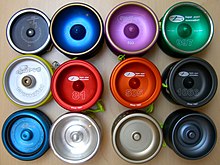
Modern yo-yos, some made of both aluminium and stainless steel
As popularity spread through the 1970s and 1980s, there were a number of innovations in yo-yo technology, primarily regarding the connexion between the string and the axle. In 1979, dentist and yo-yo celebrity Tom Kuhn patented the "No Jive iii-in-1" yo-yo, creating the globe's start "take-autonomously" yo-yo, which enabled yo-yo players to change the axle.
Swedish bearing visitor SKF briefly manufactured novelty yo-yos with ball bearings in 1984. In 1990, Kuhn introduced the SB-2 yo-yo that had an aluminum transaxle, making it the first successful ball-bearing yo-yo.[12]
In all transaxle yo-yos, ball bearings significantly reduce friction when the yo-yo is spinning, enabling longer and more than circuitous tricks. Subsequent yo-yo wielders used this ability to their reward, creating new tricks that had not been possible with fixed-axle designs.
There are many new types of ball bearings in the market which deviate from the original design and/or fabric of the standard stainless steel ball begetting. For example, a sure blazon of bearing has an in facing curved surface, to prevent the string from rubbing on the sides of the yo-yo, which would cause unwanted friction when performing intricate string tricks. Other manufacturers replicate this with a similar inwardly curved surface, simply use small-scale modifications. Some high-end bearings use ceramic composites in the assurance of the bearing, to reduce internal friction, over again making for a smoother spinning yo-yo. Precious materials such as ruby have as well been used as a material in image ball bearings for its backdrop such as farthermost hardness.[13] The fabric was commencement tested in a epitome bearing made past Wolf Yoyo Works in May 2018.
Techniques [edit]
Sleeping [edit]
The sleeper is one of the most common yo-yo throws and is the footing for about all yo-yo throws other than looping. Keeping a yo-yo spinning while remaining at the end of its uncoiled string is known as sleeping. While the yo-yo is in the "sleeping" land at the cease of the string, one tin can so execute tricks similar "walk the domestic dog", "around the world", or the more circuitous "rock the infant".
The essence of the throw is that i throws the yo-yo with a very pronounced wrist activeness so that when the yo-yo reaches the stop of the cord it spins in place rather than rolling support the cord to the thrower's hand. Most modern yo-yos take a transaxle or ball bearing to assistance this, but if information technology is a fixed axle yo-yo, the tension must be loose enough to allow this. The two main ways to do this are (one), let the yo-yo to sit at the bottom of the string to unwind, or (two) perform lariat or UFO to loosen the tension. When one decides to end the "sleeping" state, i but jerks the wrist and the yo-yo "catches" the cord and rolls back up to the hand. Ball-bearing yo-yos with a "butterfly" shape, primarily used for cord tricks, frequently accept low response or are completely unresponsive, requiring a "demark" for the yo-yo to render.
In competition, mastery of sleeping is the basis for the 1A partition. Inexpensive fixed-axle yo-yos unremarkably spin between 10–xx seconds, while the expensive brawl begetting yo-yos can spin well-nigh i–four minutes depending on the throw.[14] As of 2010[update], the world tape slumber times were 3:51.54 minutes for fixed-axle and 21:15.17 minutes for transaxle yo-yos.[fifteen] In 2012, the transaxle yo-yo slumber time tape was broken by the C3YoyoDesign BTH, with a time of 30:28.30 minutes.
Unresponsive (1A) [edit]
Eventually, wider string gaps and silicone response systems led to the innovation of unresponsive yoyoing, otherwise known as 1A. Traditional yoyos (responsive) would return to the hand when one would tug on the string, but unresponsive yoyos behave a footling differently. Instead of returning to the mitt when you tug on the string, yous take to perform a trick chosen a "bind" where the cord is doubled over inside the string gap to increment friction on the response organisation. This has brought about innovation of many different kinds of tricks involving leaving slack in the string, every bit this would accept acquired a responsive yoyo to return to the hand. This style of yoyoing is the most popular and the nearly mutual, and the most yoyo tricks are done with 1A yoyos.
Looping (2A) [edit]
Looping is a yo-yo technique which emphasizes keeping the trunk of two yo-yos, 1 on each mitt, in constant motion, with or without sleeping.[16]
Yo-yos optimized for looping take weight concentrated in their centers so they may easily rotate about the string'south centrality without their mass contributing to resistance due to a gyroscopic event.
In yo-yo competitions, looping both to the inside and exterior of the mitt with the yo-yo plays a strong role in the 2A segmentation. Sometimes the yoyos would wrap around artillery, legs, or necks.
Too known as 2 hands looping freestyle.
Two handed string tricks (3A) [edit]
Two handed or 3A mode play involves doing string tricks with two flared begetting yo-yos. Popularized and pioneered past Mark McBride, the first modern Triple A trick appeared in Fiend Magazine and was called the Velvet Rolls. The unlike mounts in this style are referred to as houses (e.thousand. "Kink Business firm").
Photos from equally early on as the belatedly 1950s show early yo-yo demonstrators performing very basic 3A tricks, such as a Sleeper with one manus, and a Trapeze with the other. While 3A as a concept has existed for many years, it was non until the debut of Velvet Rolls, coupled with the rise of unresponsive yoyo play, that development began on what is currently considered Triple A. This is the almost complex style and is the most likely to obtain knots, dings, and clangs.
In competition, two handed cord tricks have the 3A partition.
Off-cord (4A) [edit]
In the "off-string" technique, the yo-yo's cord is not tied directly to the yo-yo's axle, and the yo-yo is normally launched into the air by performing a "forward pass" to be caught once again on the string. Nonetheless, some players can 'throw down' off-string yo-yos and take hold of information technology on the string just equally it leaves the end of the string past pivoting the string around a finger every bit information technology unwinds, so that the yo-yo is defenseless on the cord. This is exactly the opposite of a "forward pass", only with the same result.
Yo-yos optimized for off-string tricks have flared designs, like the butterfly shape, which makes information technology easier to country on the cord, and often accept soft rubber rings on the edges, so minimum damage is inflicted on the yo-yo, the player, or anyone who happens to be standing nearby, should a trick go wrong. There are besides tricks which involve the use of two off-string yoyos at the same time, thrown with the aforementioned hand, this is known as "soloham".
Yo-yo competitions accept the 4A division for off-string tricks.
Freehand (5A) [edit]
In freehand tricks, the yo-yo's string is non tied to the player'south paw, instead ending in a counterweight. The counterweight is then thrown from manus to hand and used as an additional chemical element in the fob.
Developed in 1999 by Steve Brown, as of 2008 freehand is considered to be the fastest-growing manner of yo-yo play. Steve Brown was awarded a patent on his freehand yo-yo system, which was assigned to Flambeau Products (Duncan's parent company). Duncan patented the counterweight, and no i was able to design a unique weight.[17] However, since March 28, 2020, the patent has expired.
In yo-yo competitions, counterweight yo-yos are emphasized in the 5A division.
Concrete mechanism [edit]
When the yo-yo is first released, the gravity (and the throw) requite it translational kinetic energy and necessarily, since the string must unwind, much of this energy is converted into rotational kinetic energy establishing the free movement of the yo-yo, and causing information technology to spin apace. As the yo-yo unwinds down, it also converts potential free energy from gravity to both translational agh energy in its rotation to overcome gravity all the way support to the manus.
Because the sense of spinning does not modify during the whole movement, the string winds upwards in the opposite direction upon the return of the yo-yo. If the shaft of the yo-yo is connected to the string with a loop, there may not be enough frictional strength to overcome the weight of the yo-yo, which is necessary to begin winding up the string. In this case, the yo-yo will continue to spin in the loop at the end of the string (or sleep), just being slightly braked by the small dynamic friction, instead of returning. However, if the cord is jerked slightly up, or the manus is lowered, the slack created in the cord volition allow it to begin winding around the shaft, thereby increasing friction and allowing it to catch as the static friction force rises higher up the gravitation force belongings the yo-yo at the lesser of the cord, making the yo-yo wind up the cord returning to the hand.
Patents have been issued to create more complicated mechanisms to allow tension control and an adjustable machinery.[18] [19]
See also [edit]
- Chinese yo-yo
- Eskimo yo-yo
- Yo-yo balloon
References [edit]
- ^ "Definition of YO-YO". world wide web.merriam-webster.com . Retrieved September 25, 2018.
- ^ a b Miller, Stephen G. (2004). Ancient Greek Athletics . Yale University Press. pp. 169–. ISBN9780300115291 . Retrieved March 19, 2013.
- ^ a b Pedro Flores, National Yo-Yo Museum, archived from the original on January 20, 2008, retrieved February 18, 2008
- ^ Online Etymology Dictionary. Etymonline.com. Retrieved on April nine, 2012.
- ^ Hopkins, Michelle (April nineteen, 2009). "'Great ambassador' passes away". Richmond News. Archived from the original on August 30, 2009. Retrieved April 12, 2009.
- ^ "Kalmartrissan" och andra "trissor" Archived August 21, 2010, at the Wayback Automobile, County Museum of Kalmar (in Swedish)
- ^ "Kalmartrissan snurrar vidare", Dagens Nyheter Dec 19, 2012 (not available in the on-line edition) (in Swedish)
- ^ Kalmartrissan fyller seventy år, Sveriges radio, January 25, 2002, retrieved March 22, 2013 (in Swedish)
- ^ "YO–YO BANNED IN Syrian arab republic". Barrier Miner. Sydney, Commonwealth of australia. January 23, 1933. Retrieved July eight, 2018.
- ^ "Has yo-yo get a generic trademark?". genericides.org. March 31, 2020. Retrieved March two, 2021.
- ^ Flambeau Corporate Brochure, flambeau.com
- ^ Classic Toys: The Yo-Yo. Retro Planet (May 12, 2009). Retrieved on April 9, 2012.
- ^ "Wolf Yoyo Works on Instagram: "Only testing out #wolfyoyoworks Amarok with a i of 1 scarlet bearing, you saw information technology here outset! What is your favourite bearing type?"". Instagram . Retrieved July 12, 2019.
- ^ Yo-Yo Basics, howstuffworks.com.
- ^ American Yo-Yo Association website.
- ^ Science News, Calendar week of April 17, 2004; Vol. 165, No. 16, p. 250 Archived April 20, 2008, at the Wayback Machine
- ^ U.South. Patent 6,371,824 Filed March 28, 2000
- ^ U.S. Patent 6,331,132 Filed July 27, 1999; Issued December xviii, 2001
- ^ U.Due south. Patent 7,192,330 Filed October 29, 1999; Issued Dec 19, 2000
External links [edit]
- Alphabetize of yo-yo tricks
sanabriagaill1942.blogspot.com
Source: https://en.wikipedia.org/wiki/Yo-yo
Belum ada Komentar untuk "Yo Baby Yo Baby Yo Yo Baby Yo Baby Yo Gif"
Posting Komentar