Four Major Language Families Four Major Language Families Map
v.3: Classification and distribution of Languages
- Page ID
- 38668

This 2d section will facilitate your understanding of the dimensions of language beyond geographic areas and cultural landscapes. Three master questions are addressed in this department:
- How are languages classified with respect to issues of national identity and genealogical considerations?
- What are the major linguistic communication families of the world and how many speakers brand use of the respective languages?
- How does language use vary in the United States with respect to dialects of English language and multilingualism?
5.iii.1 Improvidence of Languages
Linguistic communication, like any other cultural phenomenon, has an inherent spatiality, and all languages accept a history of improvidence. Equally our ancestors moved from place to identify, they brought their languages with them. As people have conquered other places, expanded demographically, or converted others to new religions, languages have moved across infinite. Writing systems that were developed by one people were adapted and used by others. Indo-European, the largest linguistic communication family, spread across a large expanse of Europe and Asia through a mechanism that is still being debated. Later, European expansion produced much of the current linguistic map by spreading English, French, Castilian, Portuguese, and Russian far from their native European homelands.
Language is disseminated through improvidence, but in circuitous ways. Relocation diffusion is associated with settler colonies and conquest, only in many places, hierarchical diffusion is the form that all-time explains the predominant languages. People may be compelled to adopt a dominant language for social, political or economic mobility. Contagious diffusion is also seen in languages, peculiarly in the adoption of new expressions in a language. One of the most obvious examples has been in the electric current convergence of British and American English language. The British press has published booksone and articles2 decrying the Americanization of British English, while the American press has done the aforementioned thing in reverse3. In reality, languages borrow bits and pieces from other languages continuously.
The establishment of official languages is oftentimes related to the linguistic ability differential inside countries. Russification and Arabization are just ii implementations of processes that employ political power to favor ane language over another.
5.3.ii Nomenclature of Languages
In that location is no precise figure equally to the total number of languages spoken in the earth today. Estimates vary between 5,000 and 7,000, and the authentic number depends partly on the arbitrary stardom between languages and dialects. Dialects (variants of the same language) reverberate differences along regional and indigenous lines. In the case of English, most native speakers will agree that they are speakers of English even though differences in pronunciation, vocabulary and sentence structure conspicuously exist. English language speakers from England, Canada, Australia, New Zealand and United states of america of America will generally hold that they speak English, and this is also confirmed with the use of a standard written form of the language and a common literary heritage. Nonetheless, there are many other cases in which speakers volition not agree when the question of national identity and mutual intelligibility do not coincide.
The most mutual situation is when similar spoken language varieties are mutually understandable, simply for political and historical reasons, they are regarded as dissimilar languages equally in the instance of Scandinavian languages. While Swedes, Danes and Norwegians can communicate with each other in most instances, each national group admits speaking a different language: Swedish, Danish, Norwegian and Icelandic. There are other cases in which political, ethnic, religious, literary and other factors force a distinction betwixt similar linguistic communication varieties: Hindi vs. Urdu, Flemish vs. Dutch, Serbian vs. Croation, Gallego vs. Portuguese, Xhosa vs Zulu. An opposite state of affairs occurs when spoken linguistic communication varieties are not mutually understood, only for political, historical or cultural motives, they are regarded as the same language as in the case of Lapp and Chinese dialects.
Languages are normally classified according to membership in a language family unit (a grouping of related languages) which share common linguistic features (pronunciation, vocabulary, grammer) and have evolved from a common ancestor ( proto-language ). This type of linguistic classification is known as the genetic or genealogical arroyo. Languages can also be classified according to sentence structure (Due south)ubject+(Five)erb+(O)bject, Due south+O+V, V+S+O). This blazon of nomenclature is known every bit typological classification , and is based on a comparison of the formal similarities (pronunciation, grammar or vocabulary) which exist among languages.
Linguistic communication families effectually the earth reflect centuries of geographic movement and interaction amidst different groups of people. The Indo-European family unit of languages, for example, represents near half of the world's population. The linguistic communication family dominates nearly all of Europe, pregnant areas of Asia, including Russia and Republic of india, Due north and South America, Caribbean islands, Australia, New Zealand, and parts of South Africa. The Indo-European family of languages consists of diverse language branches (a collection of languages within a family with a mutual ancestral language) and numerous linguistic communication subgroups (a collection of languages within a branch that share a common origin in the relative contempo by and exhibit many similarities in vocabulary and grammer.
Indo-European Language Branches and Language Subgroups
Germanic Co-operative
Western Germanic Group (Dutch, High german, Frisian, English)
Northern Germanic Group (Danish, Swedish, Norwegian, Icelandic, Faeroese)
Romance Co-operative
French, Portuguese, Spanish, Catalan, Provençal, Romansh, Italian, Romanian)
Slavic Branch
West Slavic Grouping (Polish, Slovak, Czech, Sorbian)
Eastern Slavic Group (Russian, Ukrainian, Belorussian)
Southern Slavic Group (Slovene, Serbo-Croation, Macedonian, Bulgarian)
Celtic Branch
Britannic Grouping (Breton, Welsh)
Gaulish Group (Irish gaelic Gaelic, Scots Gaelic)
Baltic-Slavonic Branch
Latvian, Lithuanian
Hellenic Branch
Greek
Thracian-Illyrian Branch
Albanian
Armenian Branch
Armenian
Iranian Branch
Kurdish, Persian, Baluchi, Pashto, Tadzhik
Indo-Iranian (Indic) Branch
Northwestern Group (Panjabi, Sindhi, Pahari, Dardic)
Eastern Grouping (Assamese, Bengali, Oriya)
Midland Grouping (Rajasthani, Hindi/Urdu, Bihari)
West and Southwestern Grouping (Gujarati, Marāthi, Konda, Maldivian, Sinhalese)
Other languages spoken in Europe, merely not belonging to the Indo-European family are subsumed in these other families: Finno-Ugric (Estonian, Hungarian, Karelian, Saami, Altaic (Turkish, Azerbaijani, Uzbek) and Basque. Some of the language branches listed in a higher place are represented past only i principal language (Albanian, Armenian, Basque, Greek), while others are spoken by diverse groups in some geographic regions (Northern and Western Germanic languages, Western and Eastern Slavic languages, Midland and Southwestern Indian languages).
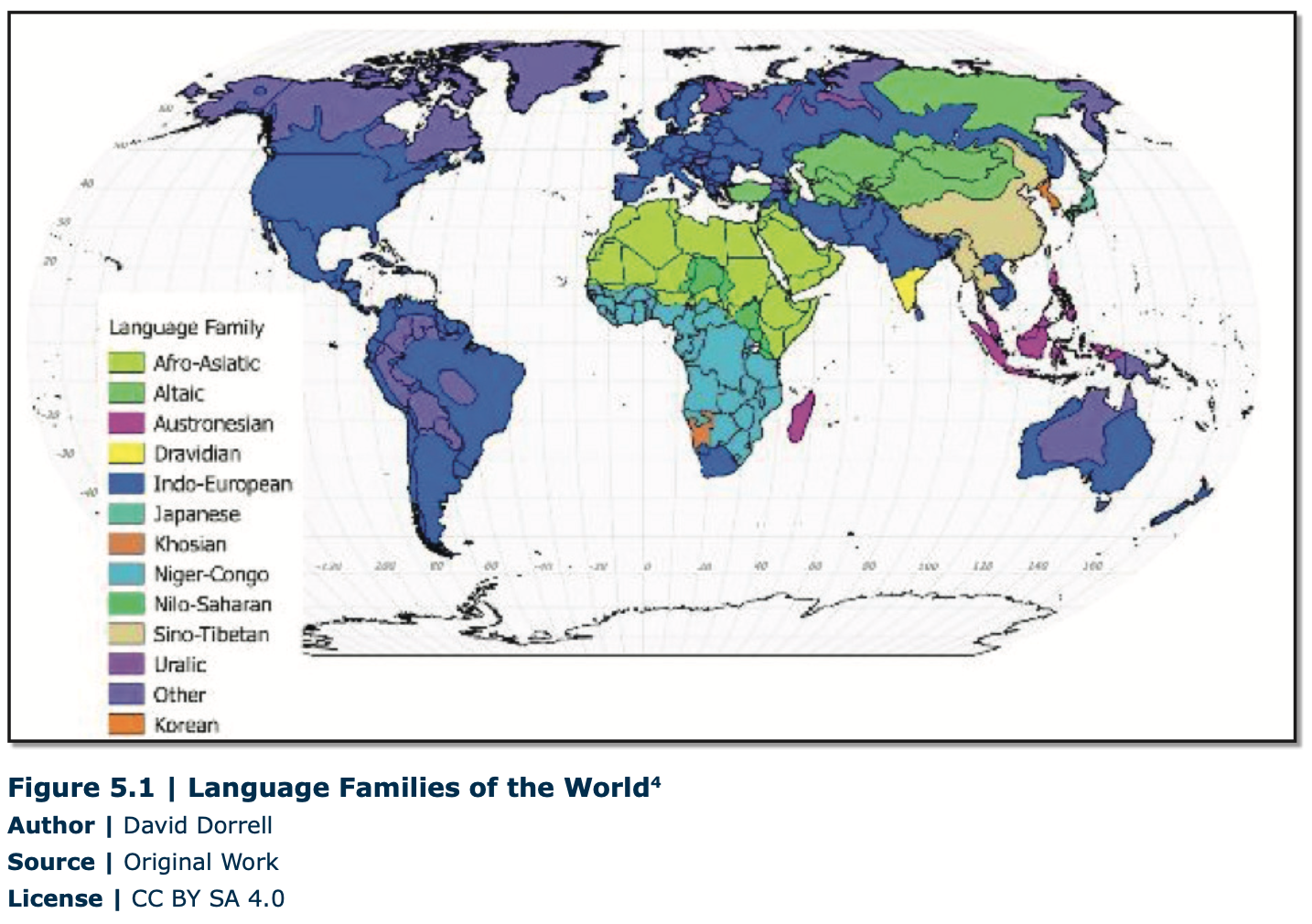
Major Linguistic communication Families of the World past Geographic Region
Europe
Caucasian Family
Abkhaz-Adyghe Grouping (Circassian, Adyghe, Abkhaz) Nakho-Dagestanian Group (Avar, Kuri, Dargwa) Kartvelian Group (Kartvelian, Georgian, Zan, Mingrelian)
Africa
Afro-Asiatic Family (Arabic, Hebrew, Tigrinya, Amharic) Niger-Congo Family (Benue-Congo, Adamawa, Kwa) Nilo-Saharan Family (Chari-Nile, Nilo-Hamitic, Nara) Khoisan Family unit (Sandawe, Hatsa)
Asia
Sino-Tibetan Family (Chinese, Tibetan, Burmese)
Tai Family unit (Laotian, Shan, Yuan)
Austro-Asiatic Family (Vietnamese, Indonesian, Dayak, Malayo-Polynesian) Japanese (an example of an isolated language)
Pacific
Austronesian Family (Malagasy, Malay, Javanese, Palauan, Fijian) Indo-Pacific Family (Tagalog, Maori, Tongan, Samoan)
Americas
Eskimo-Aleut Family (Eskimo-Aleut, Greenlandic Eskimo)
Athabaskan Family (Navaho. Apache)
Algonquian Family (Arapaho, Blackfoot, Cheyenne, Cree, Mohican, Choctaw) Macro-Siouan Family (Cherokee, Dakota, Mohawk, Pawnee)
Aztec-Tanoan Family (Comanche, Hopi, Pima-Papago, Nahuatl, Tarahumara) Mayan Family (Maya, Mam, Quekchi, Quiche)
Oto-Manguean Family (Otomi, Mixtec, Zapotec)
Macro-Chibchan Family (Guaymi, Cuna, Waica, Epera)
Andean-Equatorial Family (Guahibo, Aymara, Quechua, Guarani)
The number of language families distributed effectually the world is sizable. The linguistic state of affairs of specific member groups of the language family might exist influenced by various, interacting factors: settlement history (migration, conquest, colonialism, territorial agreements), ways of living (farming, angling, hunting, trading) and demographic strength and vitality of the speaker groups. Some languages might converge (many local varieties becoming 1 primary language), while others might diverge (ane primary language evolves into many other speech varieties). When different linguistic groups come into contact, a pidgin type of linguistic communication may be the result. A pidgin is a composite language with a simplified grammatical arrangement and a limited vocabulary, typically borrowed from the linguistic groups involved in trade and commerce activities.
Tok Pisin is an example of a pidgin spoken in Papua New Guinea and derived mainly from English. A pidgin may become a creole linguistic communication when the size of the vocabulary increases, grammatical structures become more complex and children acquire it as their native language or mother tongue. There are cases in which one existing language gains the status of a lingua franca. A lingua franca may not necessarily be the mother tongue of any one speaker group, but it serves as the medium of communication and commerce among diverse language groups. Swahili, for case, serves as a lingua franca for much of East Africa, where individuals speak other local and regional languages.
With increased globalization and interdependence among nations, English is rapidly acquiring the status of lingua franca for much of the world. In Europe, Africa and India and other geographic regions, English serves equally a lingua franca across many national-state boundaries. The linguistic consequence results in countless numbers of speaker groups who must get bilingual (the ability to use two languages with varying degrees of fluency) to participate more fully in society.
Some continents have more spoken languages than others. Asia leads with an estimated 2,300 languages, followed past Africa with ii,138. In the Pacific expanse, at that place are almost 1,300 languages spoken and in North and South America about 1,064 languages have been identified. Europe, even with its many nation-states, is at the bottom of the list with most 286 languages.
| Linguistic communication | Family unit | Speakers in Millions | Main Areas Where Spoken |
|---|---|---|---|
| Chinese | Sino-Tibetan | 1197 | Mainland china, Taiwan, Singapore |
| Castilian | Indo-European | 406 | Spain, Latin America, Southwestern United states of america |
| English | Indo-European | 335 | British Isles, Usa, Canada, Caribbean area, Australia, New Zealand, South Africa, Philippines, erstwhile British colonies in Asia and Africa |
| Hindi | Indo-European | 260 | Northern Republic of india, Pakistan |
| Arabic | Afro-Asiatic | 223 | Middle East, North Africa |
| Portuguese | Indo-European | 202 | Portugal, Brazil, southern Africa |
| Bengali | Indo-European | 193 | Bangladesh, eastern India |
| Russian | Indo-European | 162 | Russia, Kazakhstan, part of Ukraine, 0ther erstwhile Soviet Republics |
| Japanese | Japanese | 122 | Japan |
| Javanese | Austronesian | 84.3 | Indonesia |
Ten Major Languages of the World in the Number of Native Speakers five
Other important languages and related dialects, whose total number includes both native speakers and second language users, consist of post-obit: Korean (78 million), Wu/Chinese (71 million), Telugu (75 million), Tamil (74 1000000), Yue/ Chinese (71 1000000), Marä thi (71 one thousand thousand), Vietnamese (68 one thousand thousand) and Turkish (61 1000000).
Language Spread and Linguistic communication Loss
Of the top 20 languages of the world, all these languages have their origin in south or eastern asia or in Europe. There is non one from the Americas, Oceania or Africa. The absence of a major globe language in these regions seems to be precisely where near of the linguistic diversity is concentrated.
- English, French and Castilian are among the globe'southward most widespread languages due to the imperial history of the dwelling house countries from where they originated.
- Ii-thirds (66%) of the earth'south population speak 12 of the major languages effectually the globe
- About 3 percent of the world's population accounts for 96 percent of all the languages spoken today. Of the electric current living languages in the world, about 2,000 have less than 1,000 native speakers.
- Nearly half of the world'due south spoken languages will disappear by the end of this century. Linguistic extinction (language death) will impact some countries and regions more than others.
- In the U.s.a. many endangered languages are spoken by Native American groups who reside in reservations. Many languages will be lost in Amazon pelting forest, sub-Saharan Africa, Oceania, ancient Commonwealth of australia and Southeast Asia.
- English language is used equally an official language in at least 35 countries, including a number of countries in Africa (Republic of botswana, Kenya, Namibia, Sudan, Tanzania, Uganda among others), Asia (Republic of india, Pakistan, Philippines), Pacific Region (Fiji, Solomon Islands, Vanuatu, New Zealand), Caribbean (Puerto Rico, Belize, Guyana, Jamaica), Ireland and Canada.
- English is not by police (de jure) the official linguistic communication in the United kingdom, United States and Australia. English does enjoy the status of "national linguistic communication" in these countries due to its power and prestige in institutions and lodge.
- English does non have the highest number of native speakers, but information technology
is the world'due south most normally studied language. More people learn English than French, Spanish, Italian, Japanese, German and Chinese combined.6
Dialects of English language in the United States
At the time of the American Revolution, three main dialects of English language were spoken. ThesevarietiesofEnglishcorrespondedtodifferencesamongtheoriginal setters who populated the Eastward Coast.
Northern English language
These settlements in this area were established and populated almost entirely by English settlers. Nearly two-thirds of the colonists in New England were Puritans from Due east Anglia in southwestern England. The region consists of the following states: Massachusetts, New Hampshire, Maine, Connecticut, Rhode Island, Vermont, New York and New Jersey.
Southern English
About one-half of the speakers came from southeast England. Some of them came from diverse socialclass backgrounds, including deported prisoners, indentured servants, political and religious persecuted groups. The following states comprise the region: Virginia, Delaware, N Carolina, Southward Carolina and Georgia.
Midlands English
The settlers of this region included immigrants from diverse backgrounds. Those who settled in Pennsylvania were predominantly Quakers from northern England. Some individuals from Scotland and Ireland besides settled in Pennsylvania besides every bit in New Jersey and Delaware. Immigrants from Germany, The netherlands and Sweden also migrated to this region and learned their English from local English-speaking settlers. This region is formed by the following areas/states: Upper Ohio Valley, Pennsylvania, Maryland, West Virginia, western areas Northward and S Carolina.
Dialects of American English have continued to evolve over time and place. Regional differences in pronunciation, vocabulary and grammar do not suggest that a type of linguistic convergence is underway, resulting in some type of "national dialect" of American English language. Even with the homogenizing influences of radio, television, internet, and social media, many distinctive varieties of English language tin be identified. Robert Delaney (2000) has outlined a dialect map for the United States which features at least 24 distinctive dialects of English. Dialect boundaries are established using diverse criteria: language features (differences in pronunciation, vocabulary and grammar) settlement history, ethnic diversity, educational levels and languages in contact (Spanish/English in the American Southwest). The dialect map does not represent the English varieties spoken in Alaska or Hawaii. Still, it does include some urban and social (ethnolinguistic) dialects.
Full general Northern English, spoken by nearly two-thirds of the country.
New England Varieties
- Eastern New England
- Boston Urban
- Western New England
- Hudson Valley
- New York Metropolis
- Bonac (Long Island)
- Inland Northern English Varieties
- San Francisco Urban
- Upper Midwestern
- Chicago Urban
Midland English Varieties
- North Midland (Pennsylvania)
- Pennsylvania German language-English language
Western English language Varieties
- Rocky Mountain
- Pacific Northwest
- Pacific Southwest
- Southwest English
- Southward Midland Varieties
- Ozark
- Southern Appalachian (Smoky Mountain English)
General Southern English Varieties
Southern
- Virginia Piedmont
- Littoral South
- Gullah (coastal Georgia and Due south Carolina)
- Gulf Southern
- Louisiana (Cajun French and Cajun English) 7
Multilingualism in the U.s.
Language variety existed in what is now the United States long before the arrival of the Europeans.
It is estimated that at that place were between 500 and 1,000 Native American languages spoken around the fifteenth century and that at that place was widespread language contact and bilingualism among the Indian nations. With the arrival of the Europeans, seven colonial languages established themselves in different regions of the territory:
- English forth the Eastern seaboard, Atlantic coast
- Spanish in the S from Florida to California
- French in Louisiana and northern Maine
- German in Pennsylvania
- Dutch in New York (New Amsterdam)
- Swedish in Delaware
- Russian in Alaska
Dutch, Swedish and Russian survived only for a curt period, but the other iv languages go along to be spoken to the nowadays day. In the 1920'south, half-dozen major minority languages were spoken in significant numbers partly to due to massive clearing and territorial histories. The "big six" minority languages of the 1940'due south include German, Italian, Smooth, Yiddish, Castilian and French. Of the six minority languages, only Castilian and French have shown any gains over time, Spanish because of connected immigration and French because of increased "language consciousness" among individuals from Louisiana and Franco-Americans in the Northeast.
The 2015 Census data for the United States reveals valuable geographic information regarding the acme 10 states with the all-encompassing language diversity.
- California: 45 per centum of the inhabitants speak a language other than English at home; the major languages include Spanish, Chinese, Korean, Vietnamese, Arabic, Armenian and Tagalog.
- Texas: 35 percent of the residents speak a language other than English at home; Castilian
- is widely used among bilinguals; Chinese, German language and Vietnamese are also spoken.
- New United mexican states: 34 per centum of the state's population speak another linguistic communication; virtually speak Castilian simply a fair number speak Navajo and other Native American languages.
- New York: 31 per centum of the residents speak a second linguistic communication; Chinese, Italian, Russian, Castilian and Yiddish; some of these languages can be institute within the same city block.
- New Jersey: 31 pct of the state's residents speak a second language in improver to English; some of the languages spoken include Chinese, Gujarati, Portuguese, Spanish and Italian.
- Nevada: thirty pct of the population is bilingual; Chinese, German and Tagalog are used along with Spanish, the predominant second language of the Southwest.
- Florida: 29 percent of the residents speak a 2nd language, including French (Haitian Creole), German and Italian
- Arizona: 27 percentage of the residents merits to be bilingual; most speak Castilian as in New Mexico while others apply Native American languages.
- Hawaii: 26 percentage of the population claims to exist bilingual; Japanese, Chinese, Korean and Tagalog are spoken along with Hawaiian, the state's 2d official linguistic communication.
- Illinois and Massachusetts: 23 percent of their respective populations speak a second language at home; residents of Illinois speak Chinese, German, Castilian and Smoothen, especially in Chicago; residents of Massachusetts speak Spanish, Haitian Creole, Chinese, Portuguese, Vietnamese and French. viii
Top Ten Languages Spoken in U.Due south. Homes Other Than English language
Data from the 2015 American Customs Survey ranks the tiptop ten languages spoken in U.S. homes other than English. The data highlight the size of the speaker population, bilingual proficiency (fluency in the home language and English language) and degree of English proficiency (LEP, express English proficiency).
| Rank | Linguistic communication Spoken at Home | Total | Bilingualism % | Limited English language % |
|---|---|---|---|---|
| ane. | Castilian | 64,716,000 | 60.0 | forty.0 |
| two. | Chinese | 40,046,000 | 59.0 | 41.0 |
| 3. | Tagalog | 3,334.000 | 44.3 | 55.7 |
| 4. | Vietnamese | 1,737,000 | 67.6 | 32.4 |
| 5. | French | one,266,000 | 79.9 | 20.1 |
| 6. | Arabic | i,157,000 | 62.8 | 37.ii |
| 7. | Korean | i,109,000 | 46.eight | 53.2 |
| viii. | German | 933,000 | 85.1 | xiv.nine |
| 9. | Russian | 905,000 | 56.0 | 44.0 |
| 10. | French Creole | 863,000 | 58.8 | 41.2 |
Chinese includes Standard mandarin and Cantonese. French besides comprises Haitian and Cajun varieties. German encompasses Pennsylvania Dutch. 9
While a record number of persons speak a language at home other than English, a substantial figure within each immigrant grouping claimed an elevated command of English. Overall, some 60 percent of the speaker groups using a 2nd language at home were also highly fluent in English. Limited fluency in English amongst young children ranged from a loftier of 55.7 percentage in the Tagalog speaker group to a low of 14.9 percent in the German language grouping which included Pennsylvania Dutch users.x
Virtually immigrant language groups take tended to follow an intergenerational language shift in the U.s.. This first generation is basically monolingual, speaking the native language of the group. The second generation is bilingual, speaking both the home language and English. By the third generation, the cultural group is substantially monolingual, speaking only English in nearly communicative situations.
More than recently, some immigrant groups, particularly those with advanced training and degrees in professional fields (engineering science, health sciences and business), come to the United states of america with a high degree of fluency in English. At the same time, the variety of English these persons speak is usually marked by the country of origin (Republic of india, Philippines, Singapore among others). With globalization "new Englishes" accept emerged (Indian English, Filipino English, Nigerian English) which challenge the notion of a Standard English variety (British or American) for apply around the world.
sanabriagaill1942.blogspot.com
Source: https://socialsci.libretexts.org/Bookshelves/Geography_%28Human%29/Book:_Introduction_to_Human_Geography_%28Dorrell_and_Henderson%29/05:_The_Geography_of_Language/5.03:_Classification_and_distribution_of_Languages
Belum ada Komentar untuk "Four Major Language Families Four Major Language Families Map"
Posting Komentar